
Introduction
The female assassin in popular fiction usually arrives as one of two things: a broken woman running from her past, or a cold killing machine with nothing underneath. Both versions exist to be explained. Trauma motivates the first.
Emptiness defines the second. Courtney Murchie’s debut novel, Built from the End, offers a third option, and it is more interesting than either.
Isla Vranic kills people for money. She is also a published fine-art photographer whose architectural series made the cover of Geo France. She is a loyal friend, a daughter who reveres her father, and a woman with genuinely funny taste in humor. She is not trying to escape her life. She built it, deliberately, from first principles, the same way she builds every plan: starting from the end she wanted and working backwards.
The Problem With Most Female Protagonists in This Genre
The thriller genre has an old habit with women. It tends to either spare them from violence by making them victims, or justify their violence by making them damaged. A woman with a gun usually has a reason rooted in loss. A father killed, a child taken, a trauma so severe that ordinary life became impossible. The violence is reactive. It is a response to something done to her.
What Murchie does differently is remove the justification. Isla is not avenging anyone. She is not running from grief. She chose this work because she is extraordinarily good at it, it pays well, and it satisfies a particular kind of intelligence that ordinary careers cannot contain. Her motivations are not emotional. They are professional. And that shift changes everything about how her character reads on the page.
Competence as Character
Isla holds a master’s degree in chemistry from Caltech, with a thesis on advanced neurotoxins that belongs, as the book notes, to her other life. She speaks four languages without accent. She forged a legitimate Dutch ID at fourteen and drove to Antwerp simply to confirm she could. By sixteen, her photographs appeared in a regional exhibition in Montana.
This is not a list of superpowers. It is a portrait of someone who treated preparation as a discipline across her entire life. Competence, in this novel, is not a plot device. It is characterization. The reader understands who Isla is through what she is capable of, not through what happened to her.
That is a meaningful distinction. In most thrillers, a character’s history explains their present. In this book, a character’s present reveals their values. Isla’s choices, what she takes on, what she refuses, how she handles every detail of a contract, tell you everything about what she believes.
It is the kind of writing that makes you want to read it twice. Buy Built from the End at Amazon and experience Isla’s world for yourself.
The Friendship That Grounds the Story
One of the most effective structural choices in the novel is what surrounds the operational chapters. The women Isla studied with at Caltech, Sol in particular, anchor her to a version of herself that has nothing to do with contracts or kill plans. Their banter is specific, warm, and genuinely funny. It reads as the kind of friendship that exists between women who knew each other before they had anything to prove.
The contrast is not played for irony. Murchie is not making a joke about the gap between Isla’s two lives. She is making an argument: that a person can be fully present in multiple modes without either version being the false one. Isla is not performing ordinariness when she is with Sol. She is not performing control when she is alone in her apartment reviewing surveillance footage. Both are real. Both belong to the same person.
The Dedication Tells You the Point
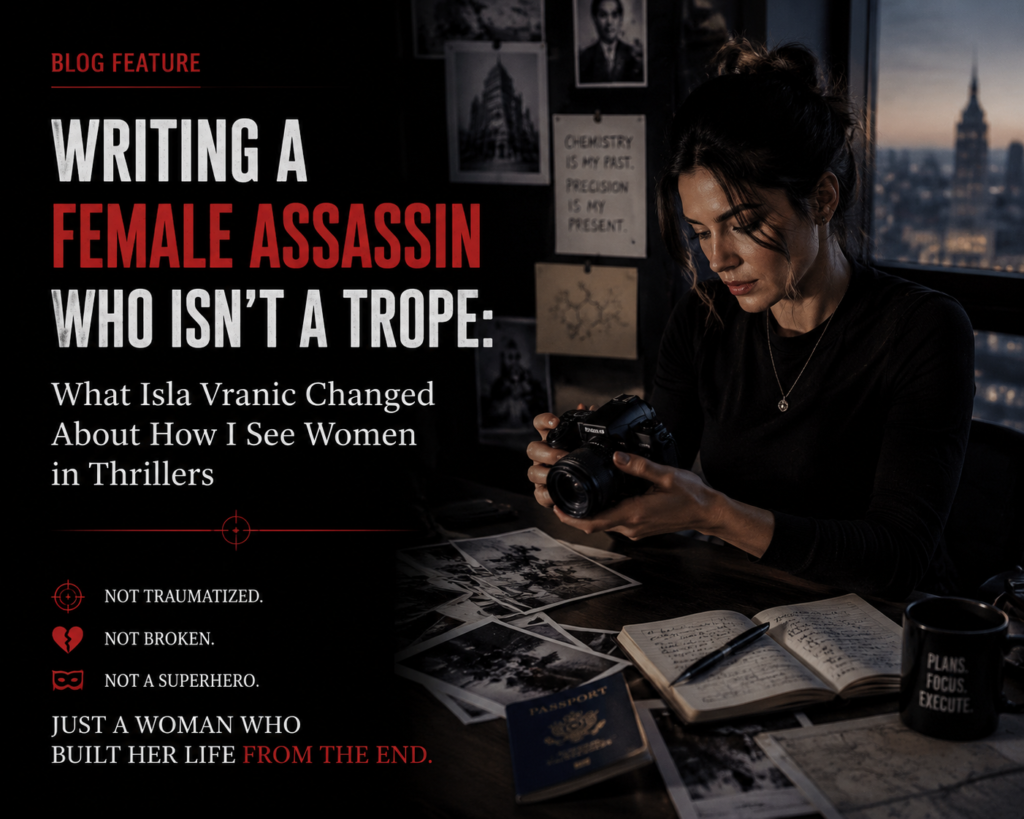
Before the story begins, there is a dedication. It reads: This is for women not traumatized, not broken and not a superhero, just regular women doing extraordinary things. That sentence is a publishing manifesto. It is the author’s explicit rejection of the frameworks the genre typically forces onto female characters.
It is also a readers’ invitation. The book is addressed, specifically and deliberately, to women who do not see themselves in the standard versions. Not the victim. Not the avenger. Not the impossible icon. The dedication signals that the story is big enough for a woman who is simply excellent at what she does, whatever that is, without needing damage to explain it.
To explore more of Courtney Murchie’s vision for this character and future projects, visit the official author website for updates and behind-the-scenes insight.
Conclusion
Isla Vranic is not the female assassin thriller has seen before. She is not defined by loss. She is not a vessel for male plotting. She is not a lesson about the cost of power. She is a woman who decided early what kind of life she wanted, built the skills required to live it, and has been executing that plan, quite literally, ever since.
The novel around her is excellent. But the character herself is the argument. Women in fiction do not need to be broken to be interesting. They just need to be written with full intelligence and genuine respect.
