
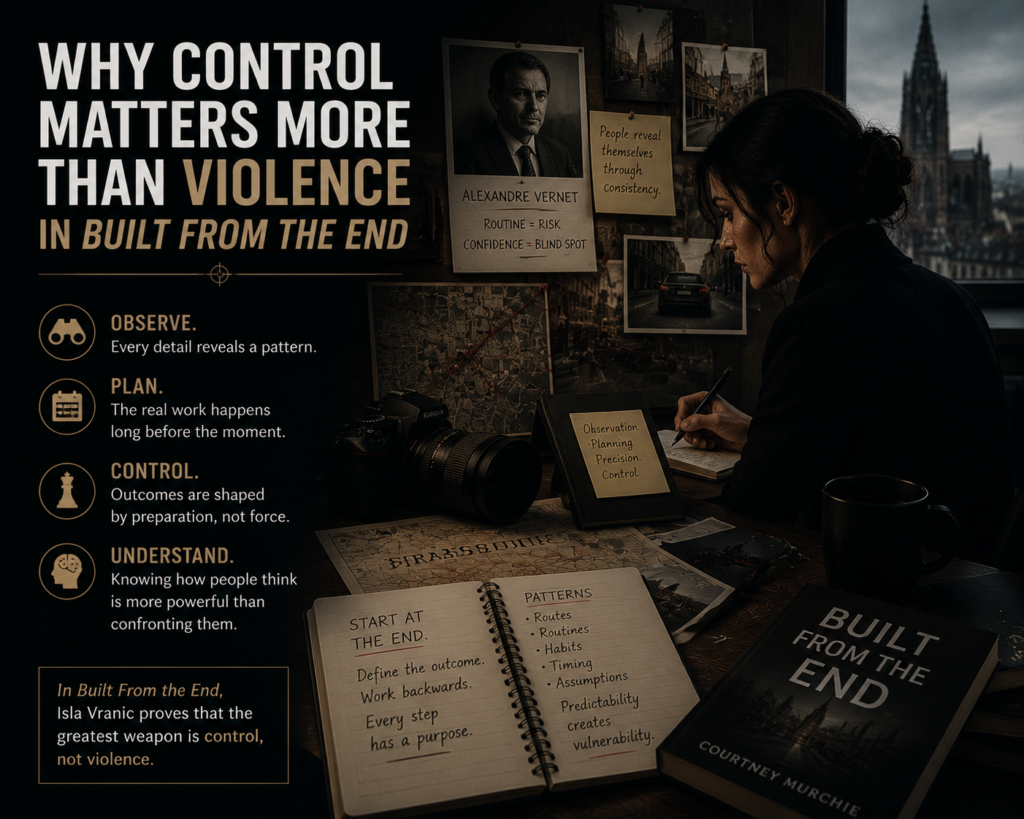
Many thrillers rely on action to create tension, but Built From the End takes a different approach. While significant events certainly occur throughout the novel, the true source of Isla Vranic’s effectiveness is not force but control. From the opening chapters, it becomes clear that she rarely reacts to circumstances in the way most people do. Rather than making decisions in the moment, she invests her time in studying, observing, preparing, and planning long before a critical situation develops.
This distinction is important because it shapes the entire atmosphere of Built From the End. Isla understands that outcomes are rarely determined by what happens during a decisive moment. Instead, they are often determined by the preparation that takes place weeks or even months beforehand. The visible result may unfold in seconds, but the real work begins long before anyone realizes an outcome has already been set into motion.
Planning Before Action
One of the defining characteristics of Isla Vranic is her commitment to preparation. Throughout Built From the End, she approaches every objective with patience and discipline, refusing to rely on improvisation when preparation can provide certainty. Before making a move, she gathers information, studies routines, examines habits, and identifies patterns that others fail to notice. Rather than focusing solely on an event itself, she focuses on everything that leads to that event.
This philosophy can be traced directly to the lesson her father taught her as a child. His advice to “start at the end” becomes the foundation of Isla’s thinking. Because she begins by identifying the desired outcome, every decision that follows serves a specific purpose. For Isla, preparation is not separate from success; preparation is the process through which success becomes possible. Every observation, every note, and every adjustment contributes to the final result she has already envisioned.
The Power of Observation
Control begins with observation, and few characters in Built From the End observe the world as carefully as Isla Vranic. Her work as a photographer reinforces this ability, teaching her to notice details that many people overlook. She pays close attention to routines, travel patterns, timing, habits, and repeated behaviors because she understands that people reveal themselves through consistency.
Throughout the novel, observation repeatedly proves more valuable than physical strength. People trust familiar paths and comfortable routines without realizing how predictable they become. Isla recognizes this tendency and understands how much information can be gathered simply by watching patiently. Her advantage comes not from overpowering others but from understanding them more clearly than they understand themselves.
Psychology Over Force
Another reason control matters more than violence in Built From the End is Isla’s understanding of psychology. She spends considerable time studying how people think, how they view themselves, and how their assumptions influence their behavior. The novel frequently demonstrates that individuals often create their own vulnerabilities through misplaced confidence or incomplete self-awareness.
Alexandre Vernet serves as a clear example of this theme. He believes he understands the systems around him, trusts the routines he has established, and assumes he recognizes potential risks. Those beliefs influence his decisions and ultimately shape his vulnerability. Isla understands that understanding a person’s thinking is often far more useful than confronting them directly. In Built From the End, psychology creates opportunities that force alone could never provide.
To learn more about Courtney Murchie, explore additional insights, and stay updated on future releases, visit the Official Author Website. If you enjoyed the themes of planning, observation, identity, and consequence discussed in this article, continue the journey with Built From the End and experience the complete story of Isla Vranic by getting your copy on Amazon.
