
Introduction
Most advice about achieving goals moves in one direction: forward. Define the goal. Break it into steps. Execute the first step. Adjust as you go. It sounds practical. It usually is not. The problem is that forward planning is optimistic by nature. It assumes the path is roughly predictable, and that the obstacles you imagine are roughly representative of the ones you will face. In practice, neither is true. Built from the End, the debut thriller by Courtney Murchie, opens with a different premise: that every plan worth making begins at its conclusion.
The title is not a stylistic flourish. It is a technical description of how the protagonist thinks. Isla Vranic, the novel’s central figure, builds every plan, whether it is a contract, a cover story, or a chess game, by identifying the precise end state she wants to create and then mapping every required step in reverse order, back to the present moment. The method originates in a childhood chess lesson. By adulthood, it has become a complete operating philosophy.
A Cabin, a Chess Board, and a Father Who Did Not Soften Things
The scene arrives in the second chapter. Isla is twelve, losing again to her father at chess in a rented cabin above Lake Zell. She is furious, not just at the loss, but at the growing awareness that she does not understand how he beats her. She calls him a cheater. He does not react.
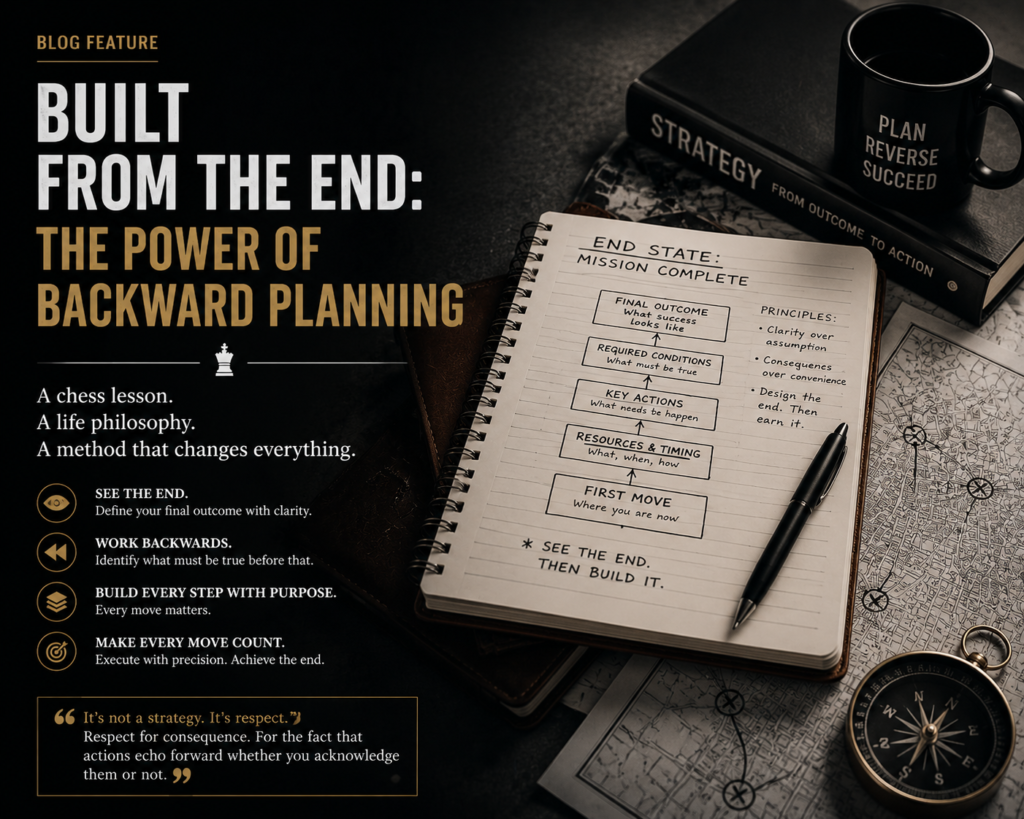
He explains, quietly, that she is trying to play forward, reading two or three moves ahead from wherever the board currently stands. And that is exactly why she keeps losing. He plays from the end. He begins by deciding how the game will finish, his opponent’s king in checkmate in a specific corner of the board, and then builds backward from that image, piece by piece, until every move he makes is in service of a conclusion that was already decided.
It is not, he tells her, a strategy. It is respect. Respect for consequence. For the fact that actions echo forward whether you choose to acknowledge them or not.
Why Forward Planning Fails
The forward-planning habit is deeply ingrained. From early education onward, people are taught to start from where they are and project outward. This is fine for simple, short-horizon tasks. For complex, long-duration goals, it tends to produce plans that are optimistic in their assumptions and fragile in their execution.
The core problem is selection bias in the imagination. When you plan forward from where you are, you tend to imagine obstacles that feel familiar, versions of problems you have already encountered. The unfamiliar ones, the category errors, the structural impossibilities, the timing conflicts, tend not to appear until you are already committed to a path that cannot accommodate them.
Backward planning forces a different kind of honesty. When you start from the desired end state and ask what would have to be true immediately before that for it to occur, you are not imagining a path. You are doing forensic work on a future that has already happened, at least in your model of it. The constraints become visible earlier. The dependencies surface before you have committed resources.
Murchie dramatizes this beautifully across the novel’s operational sequences. Buy Built from the End at Amazon to read how Isla maps every mission in reverse, from outcome to first move.
How It Appears in the Novel
Each of Isla’s contracts begins the same way. She writes the end state first, not the method, not the tools, but the specific scene she intends to produce. A man, alone, no physical trauma, a cause of death that attracts no investigation. From that image, she works backwards. What has to happen in the final moments for that scene to exist? What physical or chemical conditions have to be in place? What access and timing does that require? How far in advance does each element need to be prepared?
The result is a plan that reads, when assembled forward, as a seamless sequence of events. But it was built in reverse. The beginning was written last, which means every step genuinely serves the conclusion, rather than the conclusion being wherever the steps happen to lead.
Her father called it seeing the end and walking the path back to it before the game even starts. Isla describes it, in her own internal framing, as architecture. Load-bearing truths, stress points, and collapse that follows physics.
The Broader Application
The method is not fictional. It is embedded in several well-documented approaches to complex planning. The pre-mortem technique, popularized by psychologist Gary Klein, asks teams to imagine that a project has already failed and then work backwards to identify what caused the failure. Amazon uses a working-backwards approach to product development, beginning with the imagined press release for a finished product and then building the product to match it. Military planning has long used reverse-order planning for operations where sequencing is critical.
What the novel adds to these existing frameworks is a character who has genuinely internalized the method at the level of instinct. Isla does not sit down and consciously apply a framework. She thinks this way automatically, and the narrative is structured to show the reader what that looks like from the inside.
Learn more about the author and the thinking behind the novel at Courtney Murchie’s official website.
Conclusion
The chess lesson at the center of this novel is genuinely transferable. It does not require you to be planning a contract in Strasbourg. It requires only that you be willing to ask, before you commit to a direction: what does done actually look like? Not approximately. Specifically. Once you can answer that question with precision, the rest of the plan reveals itself. That is what Isla’s father taught her on a cold floor above a frozen lake. That is what Built from the End puts in front of every reader who picks it up.
