
Introduction
There is a chess move most people never learn. Not because it is technically difficult, but because it requires a kind of thinking that runs against every instinct.
You stop asking what you should do next. You start by asking: how does this end? That is the central idea in BuiltfromtheEnd, the debut thriller by Courtney Murchie. And the more you sit with it, the more obvious it becomes that this is not just a story about an assassin. It is a masterclass in how to think.
Isla Vranic, the novel’s protagonist, is a contract killer who operates under the alias Reid from Compliance. She is also a Caltech-educated chemist, a legitimate fine-art photographer, and a woman who speaks four languages without accent. What makes her extraordinary is not her skill set. It is her method. Before she moves a single piece on the board, she already knows how the game ends.
The Chess Lesson That Changes Everything
The philosophy in the book arrives early, in a flashback to a frozen cabin above Lake Zell. A twelve-year-old Isla has just lost to her father at chess again. She accuses him of cheating. He does not defend himself. He leans forward, elbows on his knees, and says something she will spend the rest of her life proving true:
Stop playing from the middle. Start at the end. Picture how you want it to finish, your opponent in checkmate. Build everything backwards from there.
He called it respect. Respect for consequence, for inevitability, for the way actions echo forward whether you acknowledge them or not. It was not a strategy. It was a worldview.
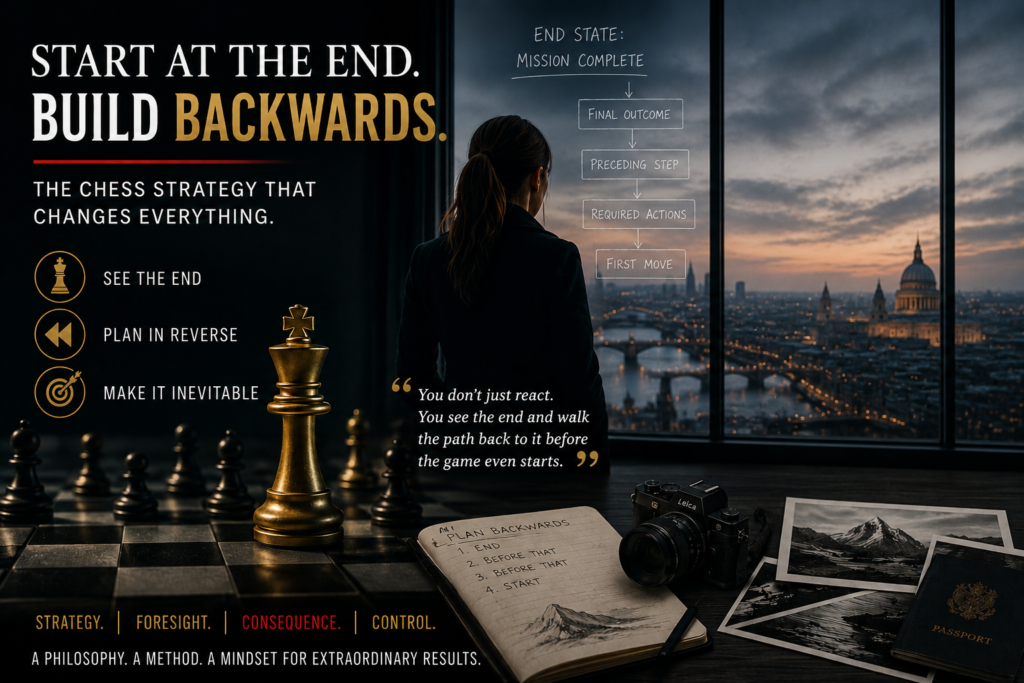
By the time Isla becomes an adult, that lesson has compounded into something formidable. She plans every contract by writing the end state first, the exact scene she wants to exist when the job is done, and then works backwards through every step required to produce it. She does not improvise. She does not react. She designs.
What This Looks Like in Practice
Most people approach goals the way an amateur plays chess. They start from where they are, make the move that looks best right now, and hope things work out. This is reactive thinking. It feels natural because it mirrors how time moves forward. But it is also why most plans fall apart the moment they meet resistance.
Backward planning works differently. You begin with the clearest possible image of the outcome you want. Not a vague aspiration, but a specific, concrete end state. Then you ask: what would have to be true immediately before this outcome for it to occur? And then: what would have to be true before that? You keep working backwards until you arrive at the first step you need to take today.
This method is used by military strategists, elite athletes, and product designers. In project management it is called inversion planning. In cognitive psychology it is linked to mental contrasting, the practice of holding the goal and the obstacles in mind simultaneously. What Murchie does in this novel is take that framework and dramatize it at the highest possible stakes.
Why This Matters Beyond the Thriller Genre
Isla is not planning a vacation or a quarterly earnings report. She is planning a sequence of events that has no margin for error. That pressure is what makes the method so visible, and so instructive. Buy the book at Amazon to see how thoroughly the philosophy is woven through every scene.
The reverse-engineering mindset that runs through this book has direct application to real decisions: career pivots, business launches, long-term health goals, financial independence plans. In every case, starting from the desired end state forces you to confront questions you would otherwise avoid. It makes the gap between where you are and where you want to be visible and measurable rather than vague and intimidating.
Most people fail not because they lack effort or ability, but because they are solving the wrong problem. They are optimizing the next step when they have not yet decided where the last step lands. Isla never makes that mistake. She says it plainly, more than once: you do not just react. You see the end and walk the path back to it before the game even starts.
A Philosophy Built for Regular People
One of the most notable things about this book is what it is not. The dedication page is direct: this is for women not traumatized, not broken and not a superhero, just regular women doing extraordinary things. That framing matters. It signals that Isla’s method is not the exclusive property of the fictional elite. It is available to anyone willing to change the direction in which they think.
The questions worth borrowing from this novel are simple. What does success actually look like, described in specific, observable terms? What sequence of events would have to occur for that outcome to exist? What is the last decision before the outcome, and the one before that? Keep walking it back until you reach something you can do today.
For more about the book and the author’s work, visit the official website to learn more about Courtney Murchie and what comes next.
Conclusion
Built from the End is a thriller that works on two levels. On the surface it is a tightly engineered espionage novel with a protagonist who is easy to admire and hard to outthink. Underneath, it is an argument for a particular way of approaching the world, one that trades hope for architecture, and instinct for design. The chess lesson Isla learned at twelve turns out to be the most transferable skill in the book. Start at the end. Build backwards. Make the outcome inevitable before you move the first piece.
