
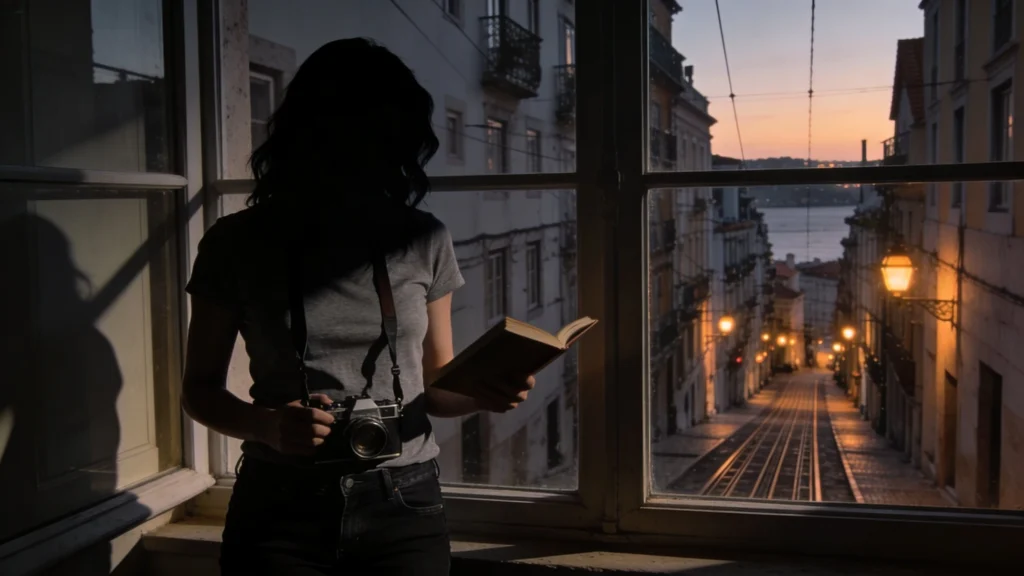
There is a particular kind of danger in the person no one notices. Not the loud one, not the threatening one, not the one who makes the room tense when they enter. The danger lives in the quiet one, the one who orders tea, adjusts her camera strap, takes a window seat, and has already memorized every exit before you sat down. That is Isla Vranic. And Built from the End, the gripping debut novel by Courtney Murchie, is her story told entirely on her terms.
The Phantom Who Photographs Cities
To the gallery panels at the Gulbenkian Foundation, Isla is an artist of rare sensitivity. In Built from the End, her photographs of Lisbon are described in the novel’s final chapter as “architectural autopsies,” images that make a city feel like a wound that hasn’t cooled. She walks into the presentation room in a gray shirt and black jeans, no makeup, hands behind her back, and leaves the panel in silence. One observer murmurs: “She walks in like a student.” Another replies: “And leaves like a phantom.”
That line is the heart of Built from the End. Isla moves through the world in a way that leaves no trace others can read correctly. She is always present. She is never truly seen. And that invisibility, cultivated over decades and refined across languages, cities, and aliases, is her greatest operational asset. It is also, quietly, the thing that isolates her most.
Built to Disappear, Trained to Destroy
From the earliest pages of the novel (p. 2–3), we learn the shape of Isla’s formation. Her mother died when she was five. Her father, rather than softening the world for her, sharpened her against it. By twelve, she could rebuild a handgun blindfolded. By fourteen, she had forged a legitimate Dutch ID and driven a rented car from Rotterdam to Antwerp simply to confirm she could. By twenty-two, she held a master’s degree in chemistry from Caltech, with a thesis on neurotoxins that belonged entirely to her other life.
She speaks four languages. She moves like a shadow through hotels, alleyways, tram lines, and surveillance blind spots. She chooses apartments based on tram access, wall thickness, and thermal camera visibility. She never uses elevators. Habits like that, she knows, save lives. She is not cautious out of fear. She is cautious out of discipline, and there is a profound difference.
The Watcher Who Can Never Be Watched
The central tension of Built from the End builds around Isla’s final contract: Vincent Lesko, a paranoid cyber-architect who has sealed himself behind layers of encryption, honeypots, synthetic spiders, and obsessive counter-surveillance. He believes he is the grandmaster. He has spent years building walls. He thinks in moves and counter-moves, in digital traps and recursive hashes.
Isla thinks in outcomes. While Lesko stares at screens, she is on foot in Lisbon at dusk, mapping his building, timing the intern’s deliveries, and noting the unmonitored maintenance hatch. She uses no electronics. Just memory. Just patience. She identifies the one gap in his sealed world, his curated health tincture, delivered weekly, trusted completely, and she fills it with a compound her Caltech research made possible. Clean. Slow-metabolizing. Activated only by the cortisol surge she has already engineered through a psychological provocation he cannot ignore.
He never sees her. He never could. That is the entire point. The title says everything: No One Knew She Was Always Watching. While Lesko hunted her digital ghost, the real Isla was standing twenty meters behind his intern on a Lisbon pavement, counting his windows, logging his motion sensors, and closing the trap.
What Murchie Does That Most Thrillers Don’t
Most thrillers create tension through danger. The protagonist is in peril; the reader is anxious for their survival. Built from the End creates tension differently. Isla is rarely in danger in the conventional sense. The suspense comes instead from watching an extraordinarily precise mind execute a plan built entirely in reverse and wondering whether the plan is truly as airtight as it appears, or whether something small and human might finally crack it.
Courtney Murchie has written a female protagonist who is not defined by vulnerability, not shaped by trauma into toughness, not softened by romance into relatability. Isla is fully, unsettlingly herself: controlled, brilliant, and watching. Always watching. The world around her is a board she has already mapped, and every person in it is a piece she has already accounted for. That is not cold. In Murchie’s hands, it is almost beautiful.
A Book That Watches You Back
There is a reason the final image of this novel is Isla sipping tea, thinking about light on a rusted train depot, already moving toward whatever comes next. She does not linger in victory. She closes the file, wipes the drive, laces her shoes, and leaves. The city she photographs will remember her work. The man she just killed will not remember her face. And the reader will not quite be able to shake the feeling that somewhere, in a quiet apartment with thermal-resistant windows and a Faraday cabinet full of burner phones, she is already watching the next one.
If you’ve ever wanted a thriller that respects your intelligence, features a female lead of genuine and uncommon depth, and delivers its tension through strategy rather than spectacle, this is exactly what you’ve been looking for.
Discover more about the world of this book at courtneymurchie.com, and order your copy now at Amazon.
